
HTML accessibility version
Written Evidence 01: On Substantive Retrospectivity, Transitional Integrity and Policy Risk Allocation in the Proposed Settlement Reforms
Committee-published written evidence (SCI0610) consolidating SWJA analysis of CP1448, substantive retrospectivity and established Skilled Worker pathways.
Written Evidence 01
Transitional Fairness and Existing Skilled Worker Pathways
Structural observations on retrospective settlement reform affecting existing Skilled Worker pathways
Topic: Addressing the Earned Settlement Policy (CP1448)
Category: Core Papers
Identifier: SWJACP01
Published: 27 February 2026
Author: Skilled Worker Justice Alliance (SWJA)
Procedural History and Methodology of Consolidation
SWJA has submitted the following written evidence to the Committee during the course of this inquiry:
Written Evidence (SCI0129) dated 1 December 2025
Written Evidence (SCI0345) dated 19 January 2026
Written Evidence (SCI0448) dated 23 January 2026
Further Supplementary Submission dated 24 February 2026
Supplementary Submission on Substantive Retrospectivity, Transitional Integrity and Policy Risk Allocation dated 27 February 2026
These submissions were made at different stages of the Committee's inquiry and address overlapping aspects of CP1448. This document consolidates the substance of the above submissions into a single structured text. Where earlier submissions contained overlapping analysis, the most developed articulation has been retained for clarity and coherence. Earlier formulations have been absorbed and integrated into the relevant sections of this document. No substantive position previously advanced has been withdrawn. No new substantive material has been introduced. This consolidated version is intended to stand as the single operative document for the Committee's consideration and, if accepted, publication.
Executive Summary
This submission examines the proposed reforms to settlement under CP1448 insofar as they apply to individuals already lawfully present in the United Kingdom and progressing under the existing Skilled Worker framework. It does not address future entrants. Its focus is limited to those already admitted to the route - and their families - who have structured their employment, residence, and financial commitments on the basis of the previously established five-year settlement pathway.
The population affected by the proposed reforms constitutes, in both design and practical operation, a clearly identifiable closed or semi-closed cohort. Its members entered the United Kingdom lawfully under an established route to settlement and have continuously accrued residence, immigration status, and eligibility within a repeatedly confirmed framework of Immigration Rules and policy. This is not a cohort seeking access to a new discretionary benefit; it is a group whose status and expectations are crystallising under an existing structure and whose life choices have been organised in reliance upon that framework.
Government materials project a significant increase in settlement grants between 2026 and 2030, including a central estimate of approximately 1.6 million grants and a projected peak around 2028. These projections are expressly described as derived from recent inflow data and cohort modelling. The projected settlement peak is therefore not an unforeseen development, but the predictable outcome of earlier policy design and admissions. In these circumstances, the relevant question is not whether projected pressures exist, but how the consequences of those pressures are allocated within the system.
Recent Immigration Rule changes demonstrate the Government's use of defined temporal boundaries to manage regulatory transition. In particular, the 4 April 2030 horizon operates as a concrete completion boundary for certain work-route cohorts admitted before April 2024. Transitional mechanisms are framed as tools for preserving legal certainty, buffering reliance, and maintaining administrative stability across policy change.
CP1448 proposes to reset the baseline qualifying period for settlement from five years to ten years, with scope for extension to fifteen years or longer. In the absence of new transitional arrangements, the framework is envisaged as applying to those already in the United Kingdom who have not yet obtained settlement. For individuals who entered the Skilled Worker route in 2023 or 2024, this would move their settlement horizon beyond the 2030 boundary previously used to define protected cohorts.
The legal framework in HSMP Forum (UK) Ltd v Secretary of State for the Home Department [2008] illustrates the public law sensitivity of altering the settlement consequences attached to an already-admitted cohort. In that case, the Court identified unlawfulness where policy changes retrospectively modified the conditions under which individuals had entered and structured their affairs. The relevance of that authority is not that the present proposal is identical in form, nor that any present unlawfulness is asserted at this stage. Rather, it underscores the constitutional importance of legal certainty and the protection of reliance where individuals have organised their lives in accordance with an established framework. Absent robust transitional safeguards, materially extending qualifying periods for those already progressing under a defined pathway risks engaging analogous Rule of Law concerns. [31]
In an already-admitted, closed or semi-closed cohort, extending the qualifying period cannot reduce cohort size. The relevant individuals are already present and progressing within the route. Altering the qualifying period therefore does not eliminate the exposure associated with projected settlement volumes; it redistributes fiscal, administrative, and compliance risks across time and across actors. The foreseeable systemic outcomes include prolonged conditionality, increased churn or early exit, and the accumulation of unresolved or precarious status. These outcomes reshape the incidence of policy exposure rather than remove it.
Although framed as applying to "future applications"the practical and legal effect of the proposals is to alter the position of those already on an established pathway. The issue is not whether settlement policy may evolve, nor whether a vested right to settlement exists. It is whether altering the legal consequences attached to residence and compliance already undertaken under a defined pathway constitutes substantive retrospectivity.
Substantive retrospectivity does not depend upon the existence of a vested entitlement, but upon whether a legal framework changes the consequences of conduct already undertaken in reliance on the prior structure. Where such change affects an identifiable and closed cohort, careful scrutiny is required to ensure coherence, proportionality, and evidential adequacy. These principles directly engage legal certainty, legitimate expectation, and the protection of reliance interests.
The supporting rationales advanced in the consultation - fairness framing, lifecycle fiscal modelling, and assumptions of domestic substitution - do not directly address the transitional and reliance implications of restructuring an already-begun pathway. Aggregate lifecycle models are not route-specific and do not demonstrate that retrospective extension of conditional status is necessary or proportionate for this defined cohort. Similarly, assumptions about domestic substitution rest on uncertain empirical foundations and do not resolve the structural consequences identified.
Independent professional and parliamentary material further indicates that these concerns are not abstract or speculative, but relate to legal certainty, workforce stability, family life, and systemic resilience. Taken together, the material before the Committee indicates that applying materially more onerous settlement conditions to those already on the Skilled Worker route, without clear and effective transitional protection, would give rise to a material risk of public law challenge, including on grounds of legal certainty, legitimate expectation, and proportionality.
The proportionate and legally coherent response is not to abandon reform, but to ensure that those already in the system are protected through clear, explicit, and operationally workable transitional arrangements, allowing them - absent compelling justification supported by evidence - to complete the route to settlement under the framework that applied when they entered it.
These issues engage not merely policy preference but constitutional principle: the coherence of retrospective effect, the integrity of established transitional boundaries, and the proper allocation of foreseeable policy risk within an existing legal framework. They arise directly from the Government's own modelling assumptions and regulatory design choices and properly fall for careful consideration within the consultation and decision-making process.
Section 1 - Policy Background: Stated Objectives and Scope
SWJA recognises the Home Office's lawful authority to amend the Immigration Rules and accepts that addressing unlawful migration, non-compliance, and abuse of the system are legitimate public policy objectives. SWJA's concern does not lie with those objectives as such, but with the proposed application of the "Earned Settlement"framework to individuals who entered lawfully, have remained compliant, and have structured their lives in good faith reliance on the existing framework. Maintaining a principled distinction between unlawful conduct and lawful reliance is essential not only for sound administration, but for fairness, legal certainty, and the rule of law. That distinction is central to the proper scope of reform and underpins the need for robust transitional protection.
The CP1448 proposals are presented against concerns about the projected scale and timing of future settlement grants and their implications for system control and public finances. The consultation materials state that, on the basis of recent inflows and cohort modelling, "settlement volumes are expected to increase between 2026 and 2030" with a "central estimate of around 1.6 million people"settling during that period and a "projected peak of around 450,000 in 2028" They further characterise this projected increase as creating pressure associated with the rights attached to settlement, including access to public funds, housing and the welfare system. In oral evidence, the Home Secretary stated that "the scale and pace of recent migration"and the fact that "without any change to the rules, the people who have arrived are soon due to be applying for settlement"were central reasons for bringing forward reform, and described the objective as securing a "managed, well-controlled system"that "retains public support"The materials explain that the purpose of the reform is fiscal and structural: to "reduce future pressure on public finances"to avoid a situation in which "large numbers of people who become eligible for settlement at the same time"create a concentration of "net public expenditure users"and to "strengthen the link between settlement, contribution and integration"in order to support the "sustainability"and "fairness"of the system. They also state that "the starting point for settlement will move from five years to ten years"that the qualifying period "can be reduced or extended"by reference to specified attributes, and that in some cases it "could be extended to fifteen years or longer"including by reference to periods of access to public funds or certain forms of non-compliance. Finally, the consultation identifies particular cohorts, including the BN(O) cohort and recent Health and Care and Skilled Worker entry cohorts, as key drivers of the projected increase in future settlement numbers, and states that, "in the absence of transitional arrangements"the new framework "will apply to people who are already in the United Kingdom and who have not yet obtained settlement when the new rules come into force"while seeking views on whether transitional arrangements should be made for those already on a pathway to settlement. [1][2][3][4][5]
For the purposes of this submission, the Government's stated objectives and the scope of the proposed changes can be summarised as follows:
Projected settlement timing and scale (forecast framing): settlement is expected to rise materially in 2026-2030, with a central estimate of around 1.6 million grants and a peak around 2028.
System pressure and entitlements framing: the projected increase is presented as creating pressure linked to the rights attached to settlement, including public funds, housing and the welfare system.
Stated objectives (control, fiscal risk, and legitimacy): the reform is presented as a response to the scale and pace of recent migration, aimed at securing a managed and well-controlled system that retains public support, while reducing future fiscal pressure and strengthening the link between settlement, contribution and integration.
Scope of change to qualifying periods: the standard five-year route is to be replaced by a ten-year baseline, capable of being reduced or extended by reference to specified attributes, and in some cases extended to fifteen years or longer.
Intended application to existing cohorts: absent transitional arrangements, the new framework is envisaged as applying to people already in the United Kingdom who have not yet obtained settlement, including cohorts identified as key drivers of the projected increase.
Section 2 - Policy Instrument
The consultation materials describe the proposed "earned settlement"framework as a restructuring of the pathway to settlement through longer baselines and calibration mechanisms. They state that "the starting point for settlement will move from five years to ten years"and that this baseline "can be reduced or extended"by reference to specified attributes, including income thresholds, English language proficiency, designated public service roles, periods of access to public funds, and certain forms of non-compliance. They further state that, for some cohorts, "we propose that they should wait 15 years before they can earn settlement"indicating that a fifteen-year period is not only a possible extension but, for some groups, a standard pathway. The materials also explain that, "in the absence of transitional arrangements, the policy will apply to people who are already in the United Kingdom and who have not yet obtained settlement when the new rules come into force"and that views are therefore being sought on whether transitional arrangements should be made for those already on a pathway to settlement. Read together, the framework is presented as a staged or points-based model in which time to settlement is recalibrated by reference to defined criteria, and is intended to operate both on future applicants and - absent transitional protection - on those already within the United Kingdom and progressing within the pathway. [1][4]
For the purposes of this submission, the structure of the policy instrument can be mapped to the same five anchors as follows:
Baseline reset aligned to the forecast window: the instrument responds to the projected 2026-2030 settlement window by replacing the five-year standard with a longer baseline.
Rights-linked calibration: the model expressly links time to settlement to criteria that include access to public funds and compliance, alongside income, English proficiency and public service roles.
Contribution-centred staging: the framework operates through staged or points-based calibration, presenting "contribution"as the organising principle for shortening or lengthening time to settlement.
Differentiated pathways (10 and 15 years+): the default baseline is ten years, with scope for fifteen years or longer for some cohorts, not merely as exceptional extensions but as standard routes.
In-system application at commencement: absent transitional arrangements, the instrument is envisaged as applying to those already in the UK who have not yet obtained settlement, with consultation on whether and how transitional protections should be provided.
Taken together, the consultation materials describe an instrument that establishes longer and differentiated baseline pathways, provides mechanisms for both upward and downward adjustment, and is intended to operate not only on future applicants but - absent transitional arrangements - on those already in the United Kingdom and progressing within the pathway, including cohorts who have structured their residence, employment and family life on the basis of the existing pathway. On its own terms, this design alters not only future conditions, but the structure of the pathway for those already progressing within it.
Section 3 - Foreseeability and Governance Choice
The issue is not whether a response to projected settlement pressures was required, but what form of response was chosen, and where within the system its costs and risks were placed.
In structural terms, the effect of the chosen response is to address upstream planning pressures by reallocating risk to those already lawfully progressing through the system, through longer and more uncertain settlement pathways.
3.1 Foreseeability based on contemporaneous data and modelling
The Government's own materials confirm that the projected settlement peak is derived from existing inflow data and cohort modelling, rather than from ex post reconstruction. A FAIRER PATHWAY TO SETTLEMENT states that projections are based on "recent inflow data and cohort modelling"and that, on this basis, "settlement volumes are expected to increase between 2026 and 2030" with a "central estimate of around 1.6 million"and a "projected peak of around 450,000 in 2028"[1]
The Technical Annex further confirms that this is a structured forecasting exercise, explaining that the analysis "uses latest data on inflows after the implementation of these measures"and that it "sets out the estimated change in inflows that might be associated with policies considered in the Immigration White Paper against a baseline in the absence of policy intervention"and that it is based on "assumptions - the analysis presented is based on a range of assumptions, including the baseline volumes and the composition of different cohorts of migrants"[6]
3.2 Transparency of administrative statistics and contemporaneous awareness
During 2021-2024, the Home Office published regular administrative statistics on Skilled Worker and Health and Care routes, which showed a marked and atypical expansion in the scale of those routes. These were not retrospective discoveries. They were contemporaneous administrative data, available to and published by the Department at the time. [3][5]
The existence of such data, and its routine use in Impact Assessments and policy appraisal, indicates not only access to information but an established capacity to map current inflows onto future cohort outcomes through tools such as cohort analysis and outflow profiles. [3]
3.3 Government acknowledgment of the causal chain
The consultation materials themselves acknowledge that the projected peak around 2028 is driven by earlier high levels of grants on work routes. A FAIRER PATHWAY TO SETTLEMENT explains that the settlement bulge in the late 2020s reflects the volume and composition of cohorts admitted in the preceding years, including 2022-2024. [1]
Ministerial evidence similarly framed the issue in explicitly cohort-based and time-bound terms, stating that "without any change to the rules, the people who have arrived are soon due to be applying for settlement"and that numbers are expected to peak, with a "central estimate"of around 1.6 million applications. [5]
3.4 Not an external shock, but a delayed reflection of earlier policy choices
Read together, these materials establish a clear causal chain: earlier decisions on the scale and composition of admissions - cohort progression over time - a projected settlement peak in the late 2020s. The "future peak"is therefore not described in the materials as an exogenous shock, but as a cohort-driven projection. It is the delayed and structurally predictable consequence of earlier, documented policy settings, assessed using data and analytical methods that were already in use at the relevant time. Even allowing for external shocks, the scale of admissions during 2022-2024 was documented and modelled contemporaneously. [1][3][6]
3.5 Governance choice and downstream allocation of risk
Against that background, the central question is not one of ignorance or unforeseeability. The materials show that the Government had access to relevant data, understood cohort dynamics, and possessed established modelling tools capable of projecting the timing and scale of the settlement peak. The issue is not whether action was needed, but that the action chosen was to adjust the settlement pathway for those already in the United Kingdom and progressing within the pathway, rather than to manage scale, pace or boundaries upstream. That is a matter of governance and policy choice, not accident. [1]
In an already-admitted, closed or semi-closed cohort - namely, people already present in the United Kingdom and progressing towards settlement - tightening settlement rules cannot remove the cohort itself. It can only change how long they wait, on what conditions, and where the fiscal, administrative and political costs of earlier policy choices are borne. In that sense, the response embodied in CP1448 is best understood as a reallocation of risk onto those already present in the United Kingdom and progressing within the pathway, rather than as a response to an unforeseeable external development.
Section 4 - Transitional Protection and the Tension with Substantive Retrospectivity
The issue is not whether new rules can be framed in forward-looking terms, but whether applying more onerous and extended settlement conditions to an already-admitted, closed or semi-closed cohort rewrites an existing pathway after reliance has accrued.
The affected population may properly be characterised, in both design and practical operation, as a clearly identifiable closed or semi-closed cohort. Its members entered lawfully and have remained compliant within an established route to settlement, accruing residence and eligibility under a stable and repeatedly applied framework.
In legal terms, this is not a group seeking access to a new benefit. It is a cohort progressing within an existing statutory and policy structure, whose expectations arise from long-standing and consistently applied rules, and therefore engage reliance interests recognised in public law. The available evidence demonstrates sustained life planning and institutional reliance across employment, family life, housing and integration. This evidential picture is consistent with that legal characterisation. Against that background, although the proposed reforms may be framed as applying to "future applications"their effect - if applied to those already on the pathway - would be to alter the legal consequences of conduct and residence already undertaken under the prior framework. To that extent, the measures would risk operating, in substance, as having retrospective effect. [11-15; 20-26]
Where a projected pressure is structurally foreseeable, the question of transitional integrity becomes central. Those affected are not new entrants. They are individuals who have been progressing along a long-established and repeatedly confirmed route, and who have organised their careers, family lives and investments on that basis. Many have already accumulated residence and status in ways that generate legitimate expectations within the existing framework. [12][15]
In that context, applying new and more demanding conditions may be presented in form as a prospective change, but in substance it operates by altering the terms of a pathway already being performed. The effect is not neutral. It changes the conditions of an existing trajectory after reliance has crystallised, and therefore engages questions of substantive retrospectivity and transitional integrity. The argument advanced here does not depend on a vested right to settlement, but on the structural integrity of an already-begun pathway. [12][15]
The issue is not whether settlement policy can change, but whether applying a restructured and lengthened pathway to those already on route cuts across the purpose and temporal boundaries of the Government's own transitional protection framework.
4.1 Transitional protection as a governing principle, not a technical add-on
Recent changes to the Immigration Rules show that transitional provisions are used to preserve the position of defined cohorts and to maintain continuity across regulatory change. The Continuous Residence guidance provides, for example, that "any absences from the UK which started before 11 April 2024 will be considered"under the approach applicable to that period, and that decisions may need to distinguish "any part of the qualifying period before 11 April 2024"[7]
The Spring Impact Assessment illustrates the governance function of phased implementation, explaining that changes were introduced in steps "to mitigate any risks"and provide certainty for families"[3]
Taken together, these statements show that transitional protection operates as a deliberate governance device, designed to protect reliance, to preserve legal certainty, and to limit the temporal reach of new rules. [3][7]
4.2 The 2030 transitional arrangement: concrete temporal anchoring and buffering
In 2025, the Government introduced an express transitional structure for work-route changes, providing that those who entered the relevant routes before April 2024 would benefit from transitional protection extending to 2030. [8][18]
Operational materials further identify the protected cohort by reference to a specific cut-off, referring to those who "employ or settle before 4 April 2030."[8][18][19] This formulation is not illustrative. It defines a concrete temporal boundary used by the system to delimit the reach of new rules and to preserve the position of those already in the route.
The logic of this arrangement, as reflected in the policy materials and accompanying explanations, is to:
Define a clear time boundary;
Provide a buffer period for existing groups;
Maintain the predictability, stability, and administrative feasibility of the system; and
Avoid unfair or disorderly retroactive impacts on existing reliance. [18][19]
The existence of such a date-anchored transitional structure demonstrates a recognition of the governance importance of clear temporal boundaries and buffering mechanisms for those already on an established pathway.
4.3 CP1448 nevertheless proposes to apply a lengthened pathway to the same already-admitted, closed or semi-closed cohorts
CP1448 states that, "in the absence of transitional arrangements, the policy will affect the already-admitted, closed or semi-closed cohort progressing within the pathway"who have not yet obtained settlement when the new rules commence, and seeks views on whether transitional arrangements should be provided for those already on a pathway to settlement. [1]
At the same time, the consultation states that "the starting point for settlement will move from five years to ten years"and asks whether, for some cohorts, "the pathway for settlement should be increased beyond the ten-year baseline"giving an example of a fifteen-year pathway. [1]
Read together, these passages make clear that, unless a new cut-off is drawn, the restructured and lengthened pathway is envisaged as operating on the very cohorts to whom the 2030 transitional logic was designed to provide boundary and buffering.
The question is not whether a vested right to settlement has accrued, but whether the legal consequences attached to residence and compliance already undertaken under a defined pathway are being altered after reliance has formed.
4.4 The collision with the 2030 boundary and the emergence of substantive retrospectivity
The practical effect can be illustrated by reference to that boundary. A Skilled Worker who entered the route in 2023 or 2024 would, under the previous five-year framework, expect to reach settlement around 2028 or 2029 - that is, before 4 April 2030, and therefore within the temporal horizon the system itself has used to define protected cohorts. [8][18][19]
If, however, the baseline is reset to ten years, that individual's settlement horizon moves to around 2033-2034; if a fifteen-year baseline applies, to around 2038-2039. Both outcomes fall after 4 April 2030. [8][18][19]
The effect is therefore not merely to change future conditions, but to push an already-admitted cohort beyond a boundary that the Government's own framework established precisely in order to provide stability and buffering.
4.5 From transitional protection to substantive retrospectivity
Where other parts of the system preserve earlier rules for conduct or residence "started before 11 April 2024" and where the framework has treated 4 April 2030 as a defined completion boundary for certain cohorts, CP1448 contemplates, absent an express new cut-off, extending the qualifying period for those already progressing within the route. [1][7]
The issue is not whether settlement policy may change, but whether applying a longer qualifying period to an already-admitted, closed or semi-closed cohort displaces what the system has itself treated as a temporal boundary designed to provide certainty and buffering. In structural terms, this risks producing substantive retrospectivity by altering the legal consequences attached to residence already undertaken under a repeatedly reaffirmed five-year framework reflected in Immigration Rules, sponsor guidance and public materials. [1][8]
Such reform engages fundamental public law constraints, including legal certainty, legitimate expectation, procedural fairness, and rational decision-making. Legal certainty requires stable and foreseeable frameworks within which individuals may organise their affairs, particularly where reliance has been encouraged by the State. Legitimate expectation arises where settled practice and consistent representation have led individuals reasonably to expect continuity absent compelling and properly justified departure. [27][28]
Where reform operates in substance to recast the consequences of past lawful conduct, the absence of clear transitional protection raises concerns not only of fairness but of systemic coherence within the Government's own transitional architecture. These concerns are reinforced by the requirement that major policy change be grounded in robust and transparent evidence and conducted through properly informed consultation consistent with established public law principles, including Moseley and Gunning.
Section 5 - Risk Allocation, Closed Cohorts, and Means-Ends Misalignment
The issue is not whether Government may seek to manage long-term fiscal and administrative exposure, but whether, in an already-admitted, closed or semi-closed cohort, the instrument chosen can do anything other than reallocate risk and externalise the costs of earlier policy choices.
For the purposes of projected settlement volumes within the 2026-2030 window, the relevant cohorts have already been admitted under prior policy settings, and their presence and eligibility trajectory are primarily determined by past inflows rather than future route design.
Those affected by CP1448 are already present in the United Kingdom and are progressing within established pathways to settlement. In structural terms, they therefore constitute an already-admitted, closed or semi-closed cohort. In such a setting, changes to qualifying conditions cannot remove the cohort itself, nor can they eliminate the long-term fiscal or administrative exposure associated with that cohort. At most, they can change the timing, conditions, and distribution of that exposure. [1][3]
5.1 From risk management to risk of reallocation
In an already-admitted, closed or semi-closed cohort, the extension and tightening of settlement conditions does not operate as upstream risk management. It does not reduce cohort size, and it does not address the upstream drivers of projected pressures. Instead, it functions as an internal redistribution mechanism - shifting when risk crystallises, who bears it, and in what form.
Rather than managing scale, pace, eligibility boundaries, or timing at the point of entry, CP1448 recalibrates the pathway at a later stage by lengthening and complicating the qualifying period. The practical effect is therefore not to remove exposure, but to defer it, reshape it, and relocate it downstream onto those already in the United Kingdom and progressing within the pathway. [1][3][6]
5.2 The three predictable outcomes for those already in the United Kingdom and progressing within the pathway
Once the pathway is lengthened to ten or fifteen years and layered with additional conditionality, individuals already in the United Kingdom and progressing within the pathway face three foreseeable and structurally determined outcomes:
Endurance: some will remain and seek to comply over a much longer and more complex pathway, absorbing prolonged uncertainty, repeated renewals, and higher compliance costs;
Exit: some will leave earlier than planned in response to extended uncertainty, higher barriers, or reduced predictability - resulting in losses to the labour market and tax base and the write-off of sunk employer and social investment; and
Limbo / irregularisation: some will fall out of continuous compliance because of ordinary life events - job changes, gaps in employment, illness, family crises, administrative delay, or error - and will not disappear from the system but remain present with unresolved, precarious, or irregular status. For clarity, "limbo"refers to situations of prolonged unresolved or precarious status short of formal removal.
In a closed cohort, these are not contingent side-effects. They are the predictable pathways through which risk is redistributed when the qualifying period is lengthened and made more complex.
5.3 The downstream incidence of costs: endurance, exit, and limbo
The consequences of this design choice are borne not by the system in the abstract, but by a defined group of lawful and compliant migrants and their employers. Costs generated by earlier policy choices - described in the Government's own materials as contributing to the projected settlement peak - are translated into longer periods of uncertainty, repeated renewal cycles, higher compliance burdens, and greater exposure to policy change. [1]
For those who endure, the cost is borne through prolonged conditionality and repeated administrative interaction. For those who exit, the cost takes the form of lost future tax contribution and the forfeiture of sunk investment by employers and individuals. For those pushed into limbo, the burden manifests as precariousness, reduced effective access to ordinary labour-market participation, and heightened exposure to administrative error and dispute. In structural terms, this represents a redistribution of administrative and compliance burdens from the system to affected individuals and sponsors, rather than an upstream adjustment of cohort scale.
Prolonged uncertainty for long-term lawful residents also carries wider human and community implications. Since the White Paper, members report sustained instability regarding their long-term position in the United Kingdom, following repeated signals of substantial rule change within a short period. For many, this represents a third episode of policy instability affecting the same cohort.
Reported impacts include anxiety, sleep disruption, and strain on family planning where long-term expectations are unsettled. Particular concern arises in relation to dependent family members, including risks of separation or forced relocation where settlement conditions are altered mid-route. These observations concern lawful residents progressing under established rules and do not relate to irregular migration.
Many individuals have made significant financial and professional commitments on the basis of the existing five-year route. Applying major changes to those already progressing within that framework may therefore have consequences extending beyond administrative adjustment, affecting wellbeing, retention, and community participation.
The Home Office retains full authority to amend the Immigration Rules. However, stability for those already on established pathways remains important for legal certainty, public confidence, and social cohesion within a rules-based system.
5.4 Foreseeable failure mechanisms and the expansion of "limbo"/p>
Lengthening the qualifying period to ten or fifteen years, and adding further layers of conditionality, gives rise to foreseeable and cumulative failure mechanisms, including:
Increased administrative and compliance costs, as longer periods of temporary status generate more renewals, more monitoring, and more scope for error and correction;
Losses to the labour market and tax base, as earlier exit becomes a rational response for some, taking with it future tax contributions and sunk investment;
Reduced investment and productivity, as extended periods of conditional status discourage long-term skills acquisition and career development;
The systematic growth of a population in limbo, comprising individuals who remain present but with unresolved, precarious, or only partially effective status; and
A deterioration in the overall cost profile of the system, as predictable, lifecycle-based expenditure is displaced by more expensive and less controllable costs associated with enforcement, correction, litigation, and crisis management. [1][18]
The United Kingdom's Windrush experience illustrates that, historically, complexity and weak status certainty have been associated with systemic status mismatches and administrative error, systemic failure, and institutional harm - risks which increase where long pathways and layered conditions expand the scope for inadvertent non-compliance and administrative mistake. [1][18]
5.5 Means-ends misalignment and a self-defeating fiscal logic
The stated objectives of CP1448 are framed in terms of fiscal sustainability, system stability, and the management of long-term pressures. However, in an already-admitted, closed or semi-closed cohort, an instrument that operates primarily by extending and complicating the pathway to settlement cannot, by its nature, eliminate the underlying exposure. It can only redistribute it over time and across actors.
There is therefore a question as to the alignment between means and stated objectives. The policy does not remove the cohort that generates the projected pressures; it reallocates risk among endurance, exit, and limbo. In doing so, it foreseeably reduces projected future tax contributions from retained skilled cohorts, increases administrative and crisis-management costs, and amplifies systemic policy risk.
The issue, therefore, is not whether settlement policy may be adjusted, but whether, in structural terms, the chosen instrument represents a coherent response to the stated objectives, or instead a reallocation and externalisation of risk that generates new and foreseeable forms of systemic failure.
Section 6 - Supporting Rationales and Analytical Defects
The issue is not whether supporting rationales can be invoked, but whether those rationales withstand scrutiny when applied to an already-admitted, closed or semi-closed cohort.
CP1448 is accompanied by a number of justificatory frames - most prominently the "fair/earned"narrative, lifecycle fiscal reasoning, and assumptions concerning domestic substitution. This section does not dispute the legitimacy of policy objectives in the abstract. Rather, it examines whether, on their own terms, these rationales provide a coherent and proportionate justification for restructuring the pathway of those already in the United Kingdom and progressing within it.
The Law Society of England and Wales has stated that the proposals risk undermining legal certainty and the rule of law if implemented without robust transitional protection, and that proceeding in the absence of such safeguards would be inconsistent with established public law principles. As the professional body representing the legal profession, its intervention is of particular relevance. It underscores the systemic implications of reform for legitimate expectation, legal certainty, and the integrity of the immigration system as a rules-based framework. [12]
The Law Society's analysis is consistent with the structural concerns identified above: namely, that absent clear and workable transitional arrangements, the proposals risk operating in substance retrospectively by altering the settled expectations of those already progressing within an established route. This question is directly connected to the coherence of the proposed reform within the Government's own transitional architecture.
6.1 The "Fair / Earned"framing
The consultation materials present the reform under the heading of a "fairer"and "earned"settlement model. However, settlement under the existing framework has never been unconditional. It has always been contingent on lawful residence, continued compliance, and satisfaction of specified criteria. The issue, therefore, is not whether contribution and compliance may be relevant to settlement, but whether the "fair/earned"framing meaningfully addresses the legally relevant questions raised by applying a lengthened pathway to an already-admitted, closed or semi-closed cohort.
In particular, that framing does not engage with questions of transitional integrity, legal certainty, or reliance. It does not explain how or why a pathway that individuals are already progressing along may be restructured mid-course without addressing the temporal boundaries previously established by the system itself. As a result, the "fair/earned"narrative operates at the level of policy description, rather than engaging with the specific institutional questions identified in Sections 3-6 as an analytical response. [1][12][14]
6.2 The lifecycle cost argument
The issue is not whether fiscal contributions vary over the lifecycle, but whether generalised lifecycle modelling justifies retrospectively extending the settlement period of an existing sponsored cohort progressing under a previously structured pathway.
The Home Office itself recognises that "the fiscal contribution of migrants varies across different migrant cohorts,"and further acknowledges that "fiscal impacts can also vary by time spent in the country."These statements properly reflect the heterogeneity and temporal variation inherent in long-term fiscal projections. They also underscore that aggregate modelling cannot substitute for cohort-specific analysis when institutional consequences are to be drawn for a defined group. [18]
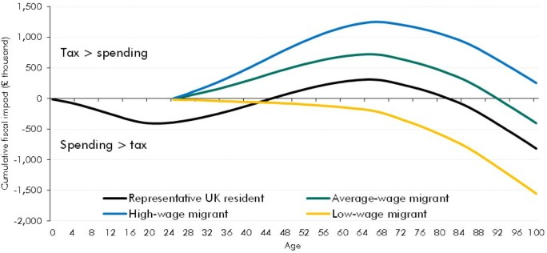
The modelling relied upon, however, is stylised and not route-specific. The OBR framework referenced is constructed around representative "average-wage,""high-wage,"and "low-wage"migrants entering at age 25, rather than the fiscal trajectory of Sponsored Skilled Workers admitted under salary-regulated, employment-verified conditions. While the document observes that certain RQF 3-5 roles are likely to make "less of a contribution than 'average wage'migrants,'it does not demonstrate that the existing Sponsored Skilled Worker cohort falls within the "low-wage"fiscal profile projected never to generate a net positive contribution. Nor does it model earnings progression, occupational mobility, sectoral retention, or return migration dynamics, all of which materially affect lifetime fiscal outcomes. [18]
The same section also notes that migrants contribute "in a number of other ways,"including through the provision of vital services. This acknowledgement reinforces that fiscal impact assessment is necessarily multi-dimensional. Lifecycle uncertainty is inherent in population-level projections. The relevant proportionality question is whether such generalised fiscal variability justifies reallocating systemic fiscal risk onto a defined cohort who entered, complied, and organised their affairs in reliance on the settlement framework as set, rather than addressing fiscal concerns through prospective route design or broader planning instruments. No published cohort-specific modelling has been presented demonstrating that retrospective extension of conditional status is necessary or proportionate in response to the considerations identified. [18]
Figure 6: OBR cumulative fiscal impact of representative migrants
6.3 The domestic substitution claim
A further assumption underlying the policy debate is that tightening settlement pathways will facilitate domestic substitution in the labour market. However, evidence before committees, including analysis by the Oxford Migration Observatory, indicates that substitution effects are uncertain, sector-specific, and often constrained by training pipelines, lag times in workforce development, working conditions, and geographic and skills mismatches.
The issue, therefore, is not whether domestic training and workforce development are legitimate objectives, but whether restructuring settlement pathways for those already in the United Kingdom is a reliable, evidence-based and proportionate instrument for achieving them. There is limited evidence on the extent to which a longer path to settlement materially affects immigration and emigration flows, and the size and distribution of any such effect are difficult to predict; indeed, analysis indicates that such changes "might also lead some migrants already in the UK to leave the country"[9][11][16]
Where exit responses and "limbo"outcomes are foreseeable (as set out in Section 5), there is a material risk of leakage rather than replacement, including reduced retention and unrecoverable employer and fiscal impacts where experienced workers exit earlier than projected. [9][11][16]
In sectors such as hospitality, community pharmacy, care, logistics and creative industries, workforce systems frequently depend upon a relatively small cohort of experienced, full-time staff who stabilise larger and more fluid workforces. Many of these roles are economically and socially essential, yet not highly remunerated within the framework's upper salary bands. Even where domestic recruitment is theoretically possible, high turnover and training lag times limit the speed and effectiveness of replacement. The short-term loss of accumulated experience, regulatory familiarity and operational continuity may therefore generate acute service disruption, even where aggregate staffing levels appear unchanged. [29][30]
In these circumstances, the question is not whether substitution is theoretically possible, but whether policy design adequately accounts for retention dynamics, transitional shocks, and system resilience. Restructuring the expectations of an existing cohort is, at best, an imprecise and speculative instrument for structural labour market correction.
6.4. The wider evidential landscape: evidential sufficiency, rationality, and economic impact
A central requirement of public law is that significant policy change be grounded in an adequate and transparent evidential foundation, particularly where it materially affects settled expectations and long-term reliance. The difficulty identified here is not merely that reasonable people may disagree about policy. It is that authoritative oversight bodies and independent analysis have identified persistent data gaps, limitations in behavioural and fiscal modelling, and uncertainty surrounding core assumptions about retention, substitution, and long-term contribution. In those circumstances, a material question arises as to whether the minimum standard of rational and informed decision-making has been satisfied.
Independent scrutiny has highlighted evidential weaknesses relevant to the assessment of costs, benefits, and distributional consequences. Parliamentary committees have drawn attention to governance and data limitations within the skilled worker system, while employer and sector bodies identify foreseeable risks to workforce stability, recruitment, retention and public service delivery arising from prolonged uncertainty. Independent academic and economic analysis likewise questions whether extending temporary status is correlated with improved compliance or fiscal contribution, and instead points to potential adverse impacts on productivity, integration and long-term planning capacity.
Material from devolved and combined authorities reinforces these concerns, identifying risks of prolonged precarity, regional labour market instability and systemic disruption. Taken together, this wider evidential landscape does not establish that restructuring settlement pathways for an already-admitted cohort is a proportionate or evidence-based instrument for achieving the stated objectives.
While the weight to be given to competing considerations ultimately lies with the decision-maker, public law requires that obviously material evidential limitations and foreseeable systemic risks be properly identified, evaluated, and addressed. Where such matters remain unresolved, serious questions arise as to rationality, proportionality, and the adequacy of the evidential foundation for reform. (See the R-, E-, M-, C- and P-series materials in the SWJA CP1448 Consolidated Evidence Bundle. Available at: https://swjauk-my.sharepoint.com/:f:/p/contact/IgAIvfitcYl5R7IPySE1vyBSAWBGpzVzitDBRZ67t8EJYUo?e=W3Omz3).
6.5 Summary: rationales do not resolve the structural problem
Taken together, these supporting rationales do not address the core structural features identified in Sections 3-6. The "fair/earned"framing does not engage with transitional boundaries or reliance; lifecycle reasoning operates at too high a level of generality to justify selective pathway restructuring; and domestic substitution claims rest on uncertain empirical foundations.
The issue, therefore, is not whether these rationales can be articulated, but whether they provide a coherent justification for applying a lengthened and more complex pathway to an already-admitted, closed or semi-closed cohort. On their own terms, they do not resolve the problems of foreseeability, transitional integrity, or risk of reallocation identified above.
Section 7 - Occupational Codes, Skill Levels, and the Administrative Trap of "Compliance Without an Exit"/p>
The issue is not whether occupational classification systems can evolve, but whether it is legitimate to make an already-admitted cohort's pathway to settlement depend on shifting administrative categories in ways that can render compliance impossible, unpredictable, or retrospectively more onerous.
CP1448 proposes a differentiated settlement architecture tied to skill levels and occupational classifications - for example, a ten-year baseline for most categories, with an increased 15-year baseline for roles below RQF level 6 (including RQF levels 3-5. In principle, classification is an administrative tool. In practice, however, when applied to an already-admitted, closed or semi-closed cohort progressing within the pathway, this design introduces structural risks that go beyond ordinary policy adjustment and may create a compliance trap: a situation in which lawful migrants are exposed to extended conditionality driven by eligibility criteria that can change over time and that individuals cannot control. [10][11][13][14][15]
7.1 Legal and practical impossibility: the "no-code-to-renew"risk
For certain occupations - illustratively, SOC 1243 (Managers in logistics) and similar roles - the current policy direction combines two moves: first, the retrospective lengthening of the settlement pathway; and second, the planned removal of those occupations from shortage or eligibility lists, or the withdrawal of the relevant codes altogether. [1][8]
For individuals already in the route, this produces a structurally incoherent outcome. They are told that they must remain in lawful, sponsored status for a significantly longer period, while the system simultaneously withdraws or closes the occupational codes through which renewal is possible. The result is not merely a higher threshold, but a situation in which continued compliance may become legally and administratively unavailable in practice. [8][18]
In such cases, the problem is not individual non-compliance, but a design that creates a closed loop: longer pathway, fewer or no viable codes, and therefore no lawful means of continuation under the revised framework. This is not merely a theoretical possibility; it creates a foreseeable risk where extended settlement horizons are tied to mutable occupational lists. [8][18]
7.2 Administrative downgrading and procedural unfairness
A second structural risk arises from the Government's ability to revise SOC frameworks and reclassify roles between versions (for example, from SOC 2010 to SOC 2020), including by reassigning roles to lower RQF levels. [8][18]
An individual may enter the system in good faith in a role classified at RQF 6, with a corresponding expectation of a ten-year pathway under the new framework. If, before they reach settlement, that role is administratively reclassified to RQF 4, the same individual can be shifted onto a fifteen-year pathway without any change in their actual work, skills, or contribution. The only change is the administrative label applied to the role. [1][8]
This is not simply a policy update. It is a form of procedural unfairness, in which the length and conditions of an already-begun pathway are altered by unilateral reclassification, rather than by any change in the individual's conduct or qualifications. In substance, it operates as a second, classification-driven retroactive tightening layered on top of the primary extension of the settlement period. [1][8]
7.3 The erosion of "successor mapping"and reliance protection
Previous practice, reflected for example in HC 590, recognises the need for successor mapping: where occupational codes change, there should be an automatic or at least structured mapping from old codes to new ones, so that individuals are not disadvantaged simply because the classification system has been updated. [19]
Using changes in SOC codes or skill-level classifications as a mechanism to lengthen settlement pathways, or to block renewal altogether, departs from that principle. It transforms what should be a neutral administrative update into a substantive worsening of legal position for people who have already organised their lives around the existing framework. [1][8]
In reliance terms, this represents a second-order interference: first, the pathway is lengthened; second, the classification system is adjusted in ways that can further extend, destabilise, or even terminate that pathway. The combined effect is to undermine the very reliance interests that transitional and successor-mapping principles are designed to protect. [1][19]
7.4 From classification to structural "compliance deadlock"/p>
Taken together, these mechanisms - code removal, reclassification, and the absence of robust successor mapping - mean that CP1448 does not merely make settlement harder or longer to reach. It creates a credible risk of structural compliance deadlock, in which:
some individuals can comply only by enduring ever longer and more uncertain renewal cycles; some are forced out of the system earlier than planned because lawful continuation becomes impracticable; and some fall into unresolved or precarious status because the system no longer offers a viable compliant route, despite their continued presence and prior lawful history.
This is not presented in the materials as an incidental by-product, but arises from the interaction between extended pathways and eligibility criteria applied through administrative classifications. It is a foreseeable consequence of binding long settlement horizons to administrative classifications in an already-admitted, closed or semi-closed cohort. In such a design, classification ceases to be a technical tool and becomes a mechanism by which risk, uncertainty, and failure are systematically redistributed onto individuals. [10][11][13][14][15]
7.5 The 2030 normative boundary and the 2028 operational cut-off
The issue is not whether transitional arrangements can be staged at different points, but whether a design that combines a normative completion boundary with an earlier operational cut-off can coherently support a lengthened pathway that necessarily runs beyond both.
Recent policy materials establish two distinct temporal devices. First, a normative boundary is used to delineate protection for existing cohorts by reference to a completion horizon before 4 April 2030, reflecting the Government's stated purpose of preserving reliance, legal certainty, and administrative stability for those already on route. Second, a separate operational cut-off - 22 July 2028 - is used to permit continued sponsorship and renewal for certain RQF 3-5 roles that would otherwise fall out of eligibility, functioning as a time-limited window for practical continuity of status. [1][4][8][17][18][19]
Taken in isolation, these devices serve different functions: the former marks a protected completion horizon, while the latter marks a temporary renewal window. However, when combined with CP1448's proposal to reset the baseline qualifying period to ten years, and in some cases fifteen years, the two devices come into structural tension.
By way of illustration, an individual who entered the Skilled Worker route in 2023 would, under the previous five-year framework, expect to reach settlement around 2028, within the United Kingdom and progressing within the pathway's own protected horizon. Under a ten-year baseline, that point moves to 2033; under a fifteen-year baseline, to 2038 - both beyond the 2030 normative boundary. At the same time, where that individual's role falls within RQF 3-5, the 2028-07-22 operational cut-off may remove the very sponsorship channel required to remain lawfully on route.
The combined effect is not merely to change future conditions, but to create a dual misalignment: the pathway is lengthened beyond the system's own completion horizon, while the practical means of remaining compliant may expire earlier. In structural terms, this creates a structural risk of compliance deadlock - a requirement to remain on a pathway for longer, coupled with a foreseeable risk that the system itself withdraws the mechanisms needed to do so.
The issue, therefore, is not the existence of transitional dates as such, but the coherence of a design that both displaces the normative boundary and constricts the operational window, while simultaneously extending the pathway beyond both. In that configuration, the predictable outcomes are those identified elsewhere in this submission: endurance under prolonged uncertainty, earlier exit, or transition into unresolved or precarious status.
7.6 Conclusion: classification as a vector of substantive retrospectivity and systemic risk
The issue, therefore, is not whether occupational codes or skill frameworks can be updated. It is whether it is constitutionally and administratively sound to make the length and viability of an already-begun settlement pathway depend on classifications that can be withdrawn, downgraded, or remapped at any time.
In structural terms, CP1448 has the effect of making administrative classification a potential vector through which substantive retrospectivity and systemic risk may arise: a means by which the conditions of an existing pathway can be worsened, destabilised, or materially harder to complete, without any change in the individual's conduct. That is not a neutral feature of system maintenance. It is a design choice that compounds uncertainty, undermines reliance, and materially increases the risk of large-scale "limbo"outcomes and compliance failure within an already-admitted cohort. [13][14][15][16]
Section 8 - Conclusion: Governance Coherence, Transitional Integrity, and Economic Rationality
The issue is not whether settlement policy may be reformed, but whether the reform, taken as a whole, is coherent in governance terms, consistent with the Government's own transitional framework, and rational in its economic and administrative effects.
Sections 3 to 5 have shown that the pressures to which CP1448 is addressed were not unforeseeable shocks, but the structurally predictable consequence of earlier, documented policy choices, assessed using data and modelling tools already in use. In that context, the choice to respond by restructuring the pathway for those already in the United Kingdom and progressing within the pathway is a matter of governance design, not necessity.
Section 4 has shown that this design sits in tension with the Government's own approach to transitional protection, including the use of defined temporal boundaries - most notably the 2030 horizon - to preserve reliance, legal certainty, and administrative stability for those already on established routes. Extending qualifying periods to ten or fifteen years for the same cohorts has the effect of displacing that boundary and raises, in structural terms, questions of retrospective coherence within the Government's own transitional architecture. [1][4][7][17]
Section 5 has shown that, in an already-admitted, closed or semi-closed cohort, the instrument chosen cannot eliminate the underlying exposure. It can only reallocate risk among three predictable outcomes - endurance, exit, and limbo - thereby externalising governance costs, eroding the tax base, increasing administrative and crisis-management burdens, and amplifying systemic policy risk. This represents a misalignment between means and ends, and a structurally counter-productive fiscal and administrative logic.
Taken together, these features raise questions not of political preference, but of governance coherence, transitional integrity, and economic rationality. The policy, as designed, seeks to address a predictable structural pressure by a mechanism that restructures existing pathways, displaces established temporal boundaries, and redistributes risk in ways that generate new and foreseeable forms of systemic failure. Substantive retrospectivity does not depend on the existence of a vested entitlement, but on whether a legal framework alters the consequences of conduct already undertaken in reliance on the prior structure.
Section 9 - Procedural Closing
The issue is not whether Government may pursue its stated objectives, but whether the structural and legal implications of the chosen instrument are expressly confronted, assessed, and answered before final determination.
The matters set out in this submission go to the coherence of the policy design, the integrity of the transitional framework, and the foreseeable administrative and economic consequences of applying the proposed model to those already in the United Kingdom and progressing within the pathway. They arise from the Government's own materials, modelling assumptions, and stated policy architecture.
These issues therefore require explicit consideration and response within the consultation and decision-making process, including a clear account of:
How transitional boundaries are to be drawn and justified;
How reliance interests are to be treated; and
How the redistribution of risk identified above is said to be consistent with the stated objectives of fiscal sustainability, system stability, and effective governance.
This submission is accordingly made not to invite any particular outcome, but to ensure that these questions are addressed on the record, as part of a lawful, rational, and procedurally complete decision-making process.
Disclaimer and Rights
This work is licensed under the Creative Commons Attribution-ShareAlike 4.0 International Licence. The Skilled Worker Justice Alliance encourages the circulation, quotation, translation, adaptation and discussion of this memorandum among stakeholders, policy makers, parliamentarians, researchers, legal practitioners, civil society organisations and affected individuals, provided that:
1. Attribution is given to the Skilled Worker Justice Alliance as the original source;
2. Any changes, adaptations or translations are clearly identified as such; and
3. Any adapted material is shared under the same or a compatible licence.
References to or adaptations of this memorandum should not misrepresent the substance of the analysis or imply endorsement by the Skilled Worker Justice Alliance unless expressly authorised.
This memorandum is provided for legislative scrutiny, public policy analysis and general information purposes only. It does not constitute, and should not be relied upon as, legal advice, immigration advice or professional advice.
The Skilled Worker Justice Alliance Ltd accepts no liability for any action taken, or not taken, on the basis of the information contained in this memorandum. Individuals affected by immigration law or policy changes should seek independent legal advice from a qualified adviser where necessary.
Materials Considered
[1] Home Office (2026) A fairer pathway to settlement: statement and accompanying consultation on earned settlement (accessible version). GOV.UK. Available at: https://www.gov.uk/government/consultations/earned-settlement/a-fairer-pathway-to-settlement-statement-and-accompanying-consultation-on-earned-settlement-accessible (Accessed: 27 February 2026).
[2] Home Office (2025) Restoring control over the immigration system (accessible version). GOV.UK. Available at: https://www.gov.uk/government/publications/restoring-control-over-the-immigration-system-white-paper/restoring-control-over-the-immigration-system-accessible (Accessed: 27 February 2026).
[3] Home Office (2024) 2024 spring immigration rules: impact assessment (accessible version). GOV.UK. Available at: https://www.gov.uk/government/publications/changes-to-immigration-rules-impact-assessments/2024-spring-immigration-rules-impact-assessment-accessible (Accessed: 27 February 2026).
[4] UK Parliament (2025) Migration: settlement pathway - Hansard, 20 November 2025. Available at: https://hansard.parliament.uk/commons/2025-11-20/debates/CE324D-7597-40C5-8697-DB48AA843CFC/MigrationSettlementPathway (Accessed: 27 February 2026).
[5] Home Affairs Committee (2026) The work of the Home Office: oral evidence transcripts. UK Parliament. Available at: https://committees.parliament.uk/work/8741/the-work-of-the-home-office/publications/oral-evidence/ (Accessed: 27 February 2026).
[6] Home Office (2025) Restoring control over the immigration system: technical annex (accessible version). GOV.UK. Available at: https://www.gov.uk/government/publications/restoring-control-over-the-immigration-system-white-paper/restoring-control-over-the-immigration-system-technical-annex (Accessed: 27 February 2026).
[7] Home Office (2025) Continuous residence guidance (accessible version). GOV.UK. Available at: https://www.gov.uk/government/publications/continuous-residence/continuous-residence-guidance-accessible-version (Accessed: 27 February 2026).
[8] Home Office (2025) Explanatory memorandum to the statement of changes to the immigration rules: HC 997, 1 July 2025 (accessible version). GOV.UK. Available at: https://www.gov.uk/government/publications/statement-of-changes-to-the-immigration-rules-hc-997-1-july-2025/explanatory-memorandum-to-the-statement-of-changes-to-the-immigration-rules-hc-997-1-july-2025-accessible (Accessed: 27 February 2026).
[9] Migration Observatory (2026) Changes to settlement: what do they mean? Available at: https://migrationobservatory.ox.ac.uk/resources/commentaries/changes-to-settlement-what-do-they-mean/ (Accessed: 27 February 2026).
[10] Praxis and GMIAU (2026) Joint briefing: statement and consultation on earned settlement. Available at: https://www.praxis.org.uk/briefings/joint-briefing-earned-settlement (Accessed: 27 February 2026).
[11] Fragomen (2026) UK earned settlement consultation and indefinite leave to remain changes - the impact on the aviation sector. Available at: https://www.fragomen.com/insights/uk-earned-settlement-consultation-ilr-changes.html (Accessed: 27 February 2026).
[12] The Law Society (2026) Government must ensure earned settlement scheme is fair and upholds the rule of law. Available at: https://www.lawsociety.org.uk/contact-or-visit-us/press-office/press-releases/government-must-ensure-earned-settlement-scheme-is-fair-and-upholds-the-rule-of-law (Accessed: 27 February 2026).
[13] ILPA (2026) ILPA response to the Government's consultation on earned settlement, 9 February 2026. Available at: https://ilpa.org.uk/ilpa-response-to-the-governments-consultation-on-earned-settlement-9-february-2026/ (Accessed: 27 February 2026).
[14] Lewis Silkin (2025) The earned settlement proposals: transitional arrangements. Available at: https://www.lewissilkin.com/insights/2025/12/18/the-earned-settlement-proposalstransitional-arrangements (Accessed: 27 February 2026).
[15] Berry, A. (2026) Manufacturing segregation - the Home Office earned settlement proposals. Cosmopolis. Available at: https://cosmopolismigration.com/2026/02/09/manufacturing-segregation-the-home-office-earned-settlement-proposals/ (Accessed: 27 February 2026).
[16] Movement Research Unit (MRU); Skilled Worker Justice Alliance (SWJA) (2026) Evidence Note 02: Technical Analysis and Workforce Impact Assessment of Proposed Retrospective Settlement Reform. SWJANE02. Available at: https://swja.uk/publications/retrospective-settlement-reform-workforce-impact/ (Accessed: 1 June 2026).
[17] Skilled Worker Justice Alliance (SWJA) (2026) Before-and-After Consultation Wording Evidence. SWJANE04. Available at: https://swja.uk/publications/consultation-wording-transitional-arrangements/ (Accessed: 1 June 2026).
[18] Home Office (2025) Statement of changes to the immigration rules: HC 997, 1 July 2025 (accessible version). GOV.UK. Available at: https://www.gov.uk/government/publications/statement-of-changes-to-the-immigration-rules-hc-997-1-july-2025/statement-of-changes-to-the-immigration-rules-hc-997-1-july-2025-accessible-version (Accessed: 27 February 2026).
[19] Home Office (2025) Spring 2025 immigration rules impact assessment (Skilled Worker and Care Worker), July 2025 (accessible version). GOV.UK. Available at: https://www.gov.uk/government/publications/statement-of-changes-to-the-immigration-rules-hc-997-1-july-2025/spring-2025-immigration-rules-impact-assessment-skilled-worker-and-care-worker-july-2025-accessible-version (Accessed: 27 February 2026).
[20] UK Parliament (2026) Indefinite Leave to Remain, Hansard, HC Deb 2 February 2026. Available at: https://hansard.parliament.uk/commons/2026-02-02/debates/A0693D73-AD95-418E-86A6-FAB882454522/IndefiniteLeaveToRemain (Accessed: 27 February 2026).
[21] Duncan-Jordan, N. et al. (2026) Letter to the Home Secretary regarding proposed restrictions to settlement rights, 11 January. London: House of Commons. Available at: https://swja.uk/publications/retrospective-settlement-change-open-letter/ (Accessed: 1 June 2026).
[22] UK Parliament (2025) Five-year indefinite leave to remain pathway for Skilled Worker visa holders (EDM 1956), tabled 13 October. London: House of Commons. Available at: https://edm.parliament.uk/early-day-motion/64360/fiveyear-indefinite-leave-to-remain-pathway-for-skilled-worker-visa-holders (Accessed: 27 February 2026).
[23] All-Party Parliamentary Group on Migration (2026) Parliamentary Casework Insights on the Earned Settlement Proposals. London: APPG on Migration. Available at: https://appgmigration.org.uk/the-earned-settlement-model/parliamentary-casework-insights-on-the-earned-settlement-proposals/ (Accessed: 27 February 2026).
[24] NHS Employers (2025) Written evidence submitted by NHS Employers (RTS4240). December. Available at: https://swja.uk/documents/pdfs/nhs-employers-written-evidence-earned-settlement-retrospective-impact.pdf (Accessed: 1 June 2026).
[25] TheCityUK (2026) Response to the Home Office consultation on Earned Settlement. Available at: https://www.thecityuk.com/our-work/response-to-the-home-office-consultation-on-earned-settlement/ (Accessed: 1 June 2026).
[26] Piletska, A. (2026) How the tech sector can respond to the government's Earned Settlement consultation and why it matters. techUK news and views, 22 January. Available at: https://www.techuk.org/resource/how-the-tech-sector-can-respond-to-the-government-s-earned-settlement-consultation-and-why-it-matters.html (Accessed: 27 February 2026).
[27] UK Parliament, Justice and Home Affairs Committee (2025) Uncorrected oral evidence: Settlement, citizenship and integration, Evidence Session No. 5, 16 December. Available at: https://committees.parliament.uk/oralevidence/16928/pdf (Accessed: 27 February 2026).
[28] UK Parliament, Public Accounts Committee (2025) Govt visa changes lost sight of risk of exploitation of migrant workers, PAC report finds, 4 July. Available at: https://committees.parliament.uk/work/9040/immigration-skilled-worker-visas/news/208184/govt-visa-changes-lost-sight-of-risk-of-exploitation-of-migrant-workers-pac-report-finds/ (Accessed: 27 February 2026).
[29] Scottish Government (2026) Letter from International Relations, Population and Migration Division regarding settlement qualifying period, 9 January. Available at: https://swja.uk/publications/scotland-earned-settlement-response/ (Accessed: 1 June 2026).
[30] Greater Manchester Combined Authority (2026) Email response regarding CP1448 Earned Settlement proposals, 2 February. Available at: https://swja.uk/publications/greater-manchester-workforce-resilience/ (Accessed: 1 June 2026).
[31] HSMP Forum (UK) Ltd v Secretary of State for the Home Department [2008] EWHC 664. Available at: https://www.casemine.com/judgement/uk/5a8ff73660d03e7f57ea9b48 (Accessed: 27 February 2026).