
HTML accessibility version
Who Stays, Who Relies: Skilled Worker Retention and Transitional Protection
Evidence analysis of what MAC administrative records show about Skilled Worker retention, and what they cannot justify for existing five-year settlement pathways.
Who Stays, Who Relies: Skilled Worker Retention and Transitional Protection
What MAC Administrative Evidence Shows - and Cannot Justify
Source analysed: MAC administrative records report, Who stays, who leaves? Evidence from the Skilled Worker route
Category: Core Papers
Identifier: SWJACP05
Published: 4 June 2026
Author: Skilled Worker Justice Alliance (SWJA)
Executive Summary
This core analysis paper considers the Migration Advisory Committee ("MAC") report, Who stays, who leaves? Evidence from administrative records on the Skilled Worker route, published on 12 May 2026 [M1]. It advances a narrow SWJA proposition: the MAC evidence is consistent with, and materially supports, treating the Skilled Worker route as a long-term settlement pathway; it does not, of itself, support retrospective or substantively retrospective alteration of that pathway for existing participants.
The report is useful because it examines which Skilled Worker main applicants historically continued to hold valid UK immigration status. It is not, however, a study of transitional fairness. It does not answer whether it is fair, coherent, administratively sound or lawful to change settlement conditions for people who entered, worked, renewed, complied and planned under an established five-year framework.
This paper distinguishes MAC's descriptive evidence from SWJA's legal and policy inference. The factual citation is MAC's; the use made of it here is SWJA's, drawing on SWJA's earlier analysis of transitional fairness, structural progression and the existing five-year settlement framework [M2] [M3]. Properly read, the report supports prospective route design, salary policy and workforce planning. It should not be used as a sufficient basis for mid-pathway alteration of existing Skilled Worker settlement pathways. The report should therefore be treated as evidence for prospective route calibration, not as a transitional-impact assessment capable of justifying changes to the settlement expectations of existing Skilled Worker participants.
Key Points
- The MAC report shows that the Skilled Worker route is administered and measured through long-term status outcomes, including settlement and citizenship.
- It answers a descriptive retention question, not the transitional fairness question.
- Its main regression evidence concerns 2014-2019 Tier 2 cohorts and cannot simply be applied to post-2020 Skilled Worker cohorts.
- Lower-paid, health/care and in-country switching migrants often show higher retention, which indicates deeper reliance rather than lower vulnerability.
- The report supports prospective policy design, not retrospective alteration of existing five-year settlement pathways, and cannot substitute for a transitional-impact assessment.
The Question the Report Answers - and the Question It Does Not Answer
The MAC report examines migrants on the Skilled Worker routes, including Tier 2 (General), Skilled Worker and Health and Care Worker visas. It asks whether they continue to hold valid UK immigration status, meaning a valid visa, indefinite leave to remain ("ILR") or citizenship [M1]. It links Home Office Migrant Journey data, visa application data and Certificate of Sponsorship data, giving a more granular administrative picture than the ordinary Migrant Journey publications.
That is an important contribution. It shows that retention varies by salary, industry, occupation, age, gender, nationality, entry route and other characteristics. It also shows that Skilled Worker migration cannot sensibly be analysed as one undifferentiated category. But the report's question is descriptive: who retains valid immigration status? SWJA's question is transitional: what should happen to people already inside a settlement pathway when government changes the route conditions mid-way?
The distinction matters. The MAC report may legitimately inform future route design, salary policy and workforce planning. SWJA's concern is not with prospective reform as such, but with using descriptive retention evidence to justify mid-pathway alteration for existing participants. The report itself states that its analysis focuses on determinants of stay rates and does not tell us what the impacts of changing settlement rules would be on migrants or on the United Kingdom [M1]. It cannot substitute for a transitional-impact assessment; it cannot assess reliance, sunk costs and household effects for existing cohorts; and it cannot show that extending ILR qualifying periods would be net beneficial for retention, integration, public services or employers.
The Five-Year Settlement Horizon
The MAC report is consistent with SWJA's evidence that the Skilled Worker route has operated, in practical administrative terms, as a settlement pathway. The report's background section identifies settlement as ILR and records the current Skilled Worker settlement requirements: five years' relevant residence, continuing sponsorship, satisfaction of salary requirements and the Knowledge of Life in the UK requirement [M1].
The five-year point is not incidental. MAC models whether a person still holds valid status after five years; the Rules currently use five years as the core settlement qualification point; and the report states that, after six years, leave expiry becomes rare because most migrants have either left the United Kingdom or obtained ILR [M1]. The official administrative data therefore treats five years as an institutional hinge.
The MAC report should also be read alongside the public-facing route materials considered in SWJACP04. This public-facing route picture is not relied on as a promise that the Rules can never change. Its relevance is narrower: it shows the administrative and communicative context in which individuals planned, renewed, worked and complied. The route was presented and operated as one capable of settlement after five years [M4] [M5] [M6] [M7] [M8] [M9] [M10].
Even if a legal change operates formally from a future date, it may be substantively retrospective if it changes the settlement consequences of residence, work and compliance already undertaken under the existing framework. That analysis does not require treating the Rules as immutable. It rests on a narrower distinction between ordinary prospective rule adjustment and depriving already accrued residence, work and compliance of their settlement significance within a published five-year progression framework. That is the point at which descriptive retention evidence becomes insufficient: it cannot replace a proper transitional assessment.
Evidence Limits: Cohort Mismatch, Valid Status and Dependants
The central evidence-scope limitation is cohort mismatch. The MAC dataset covers main applicant Skilled Worker journeys between 2014 and 2024, but the most policy-significant regression analysis is confined to those who arrived between 2014 and 2019, so that a five-year outcome can be observed [M1]. Those entrants were principally within the Tier 2 (General) system.
The route changed materially after December 2020. Tier 2 (General) was replaced by the Skilled Worker route; the skill threshold was lowered; the resident labour market test, annual CoS cap, cooling-off period and six-year limit were removed; and the Health and Care Worker route was launched and later expanded to care workers and home carers [M1]. A model based on 2014-2019 Tier 2 entrants cannot simply be treated as a behavioural model for post-2020 Skilled Worker and Health and Care Worker participants.
That is not a technical footnote. It goes directly to the evidential use that may properly be made of the report. The report can support prospective calibration of future rules. It cannot, without further evidence and a proper transitional assessment, provide a sufficient basis for changing the settlement conditions of people already inside a materially different post-2020 Skilled Worker framework.
The report also measures valid immigration status, not physical presence. It relies on visa expiry as a proxy for departure, while recognising that some migrants may leave before expiry and others may overstay [M1]. That limitation matters especially for higher earners, who are more likely to receive five-year visas and may have left before expiry, meaning their apparent stay duration may be overstated. If apparent retention is partly a function of visa validity rather than actual residence, it should not be used to infer behavioural commitment or settlement dependence without further evidence.
The dependant limitation is equally important. MAC states that it is not currently possible reliably to link main applicants and dependants in the underlying Home Office microdata [M1]. That is a material limitation for any policy extending conditional residence. Settlement delay is experienced by households, not only by main applicant records. It affects partners, children, housing, schooling, childcare, direct immigration costs, IHS exposure, employment choices and family-life stability. A settlement reform that extends conditional residence without modelling dependant effects would be incomplete as a policy assessment. This connects with SWJACP03's analysis of poverty exposure under prolonged conditional progression [M11].
Retention, Salary and Reliance
The MAC report weakens any simple salary-first theory of retention. It records that migrants initially earning less than GBP40,000 have the highest stay rates, while the highest salary band, above GBP125,000, appears to have lower long-term stay rates [M1]. It also identifies lower retention in higher education and natural and social science roles, while recognising variation across occupations [M1].
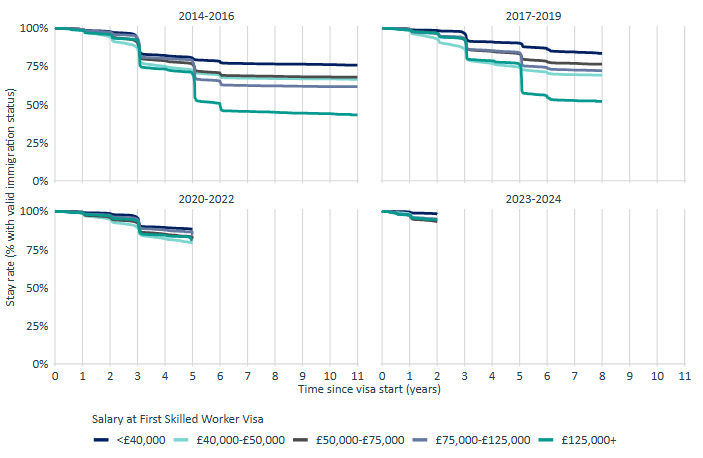
Figure 1. MAC Figure 4.7: Stay rate by salary and visa start date cohort. Source: MAC internal analysis, GOV.UK (M1). Interpretation: higher earnings do not necessarily correspond with stronger long-term retention, weakening the use of salary as a settlement-value proxy.
The sound inference is not that all high-skilled or technical workers leave. It is that salary is a poor proxy for settlement responsiveness. For globally mobile groups, accelerated settlement may be a weak retention instrument. For embedded groups, prolonged settlement qualification would materially prolong insecurity.
The report's most policy-sensitive finding is that lower-paid Skilled Workers and health/care workers have high retention. It records particularly high stay rates in human health and social work: for 2014-2019 entrants, 88.2% in that sector still held valid immigration status after five years, compared with 76.4% in other industries [M1]. Nurses show especially high retention, with 94% still holding valid status five years after arrival [M1]. Care workers and home carers should be treated cautiously because they entered the route only in 2022, leaving a shorter period for long-term observation [M1].
Those findings should not be used to say that lower-paid or health/care workers can safely be left in longer conditional status because they are unlikely to leave. Reliance is used here in a specific public-law and policy sense: route-specific planning, labour-market embedding and exposure to loss if the framework is altered mid-pathway, not a claim that individuals are literally unable to leave. To treat high retention as a reason to prolong conditionality would convert reliance from a reason for protection into a reason for burden. The better inference is that high retention is evidence of deeper reliance, stronger labour-market embedding and greater exposure to the costs of prolonged conditionality.
MAC itself points towards reliance mechanisms. It identifies sustained labour demand, public-sector job security, the administrative burden of transferring licensed health roles across countries, and household factors including dependants and children's schooling as plausible contributors to high retention in health and social care [M1]. Those are not reasons to prolong insecurity. They are reasons to recognise that existing participants may have built lives and institutional dependencies around route stability. Even allowing for the visa-validity limitation identified above, sector-specific high retention remains material evidence of embedding; the limitation affects the inference that may be drawn from apparent status retention, not the relevance of sectoral reliance.
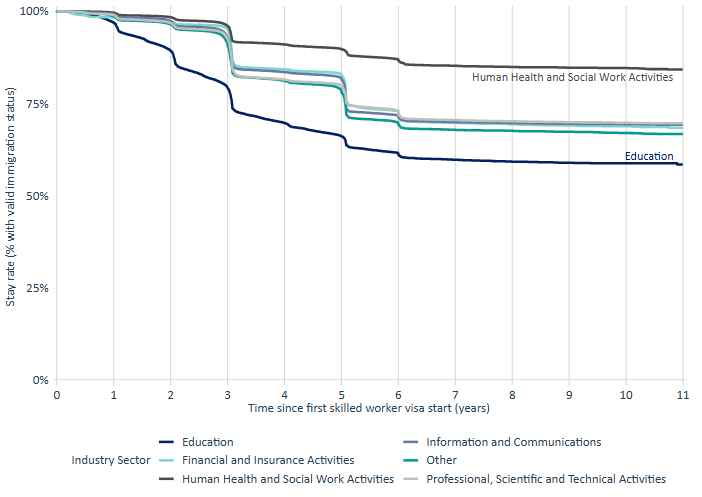
Figure 2. MAC Figure 4.8: Stay rate by industry. Source: MAC internal analysis, GOV.UK (M1). Interpretation: high retention in health and social care is better understood as labour-market embedding, not as permission to prolong insecurity.
In-Country Switchers and Existing UK Ties
MAC finds that migrants obtaining their first Skilled Worker visa in-country are more likely to remain than those applying from outside the United Kingdom [M1]. The report describes this as intuitive: people already present have had longer to build language and cultural ties and have already made an active decision to remain by applying for a Skilled Worker visa [M1].
This is consistent with SWJA's reliance analysis. In-country switching is not merely a technical migration category. For many people it marks prior residence, education, work, community attachment and private-life formation before the Skilled Worker period begins. The report records that many in-country switchers came from Student and Graduate routes, including 138,000 from Student and 59,000 from Graduate routes in the 2021-2024 Skilled Worker cohort [M1].
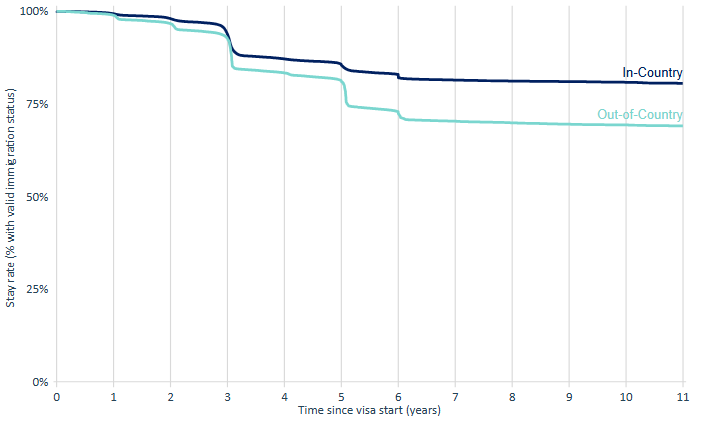
Figure 3. MAC Figure 4.6: Stay rate by entry route to the Skilled Worker visa. Source: MAC internal analysis, GOV.UK (M1). Interpretation: stronger stay patterns among in-country switchers are consistent with prior UK ties and reliance formed before Skilled Worker permission.
Evidence Use: What the MAC Report Shows and Does Not Show
| MAC evidence shows | It does not show |
|---|---|
| Who retains valid immigration status, not necessarily physical presence | Whether settlement rules should change for existing participants |
| Retention varies by salary, sector and entry route | That salary is a reliable proxy for settlement value |
| Health/care and lower-paid groups often have high retention | That they can fairly bear longer conditionality |
| In-country switchers show stronger retention | That prior UK ties can be disregarded |
| Historical Tier 2 cohorts can inform future design | That post-2020 Skilled Worker cohorts should lose existing expectations |
Proper and Improper Uses of the MAC Report
The proper use of the MAC report is prospective. It can inform future route design, future salary and occupation policy, workforce planning, and the evidence that should be gathered before altering settlement conditions. It is especially useful because it shows that retention is heterogeneous and cannot be reduced to a single salary, sector or skills proxy.
The improper use would be to treat the report as a justification for extending settlement qualifying periods for existing Skilled Worker participants. Three errors would follow:
Retention-to-Burden Error: because some groups are more likely to stay, they can be asked to bear longer uncertainty.
Salary-Proxy Error: high salary should automatically purchase faster settlement because high salary equals higher settlement value.
Historical-Forecast Error: historical valid-status retention predicts the effect of changing settlement rules.
The report does not support those moves. It does not model behavioural responses to settlement reform because no such reform existed within the underlying dataset.
MAC's nationality analysis adds a further caution against simple fiscal or retention assumptions. MAC Figure 4.3 shows that five-year stay rates are negatively correlated with GDP per capita in migrants'countries of nationality: migrants from wealthier countries are, on average, less likely to remain long term, although there is substantial variation [M1]. This does not prove that extending settlement qualifying periods would worsen fiscal outcomes. It does, however, weaken any assumption that a longer route would reliably retain the most globally mobile groups whose future fiscal contribution the policy may seek to secure. Instead, it suggests a selection risk: prolonged conditionality may fall most heavily on those with fewer exit options and deeper UK-based reliance.
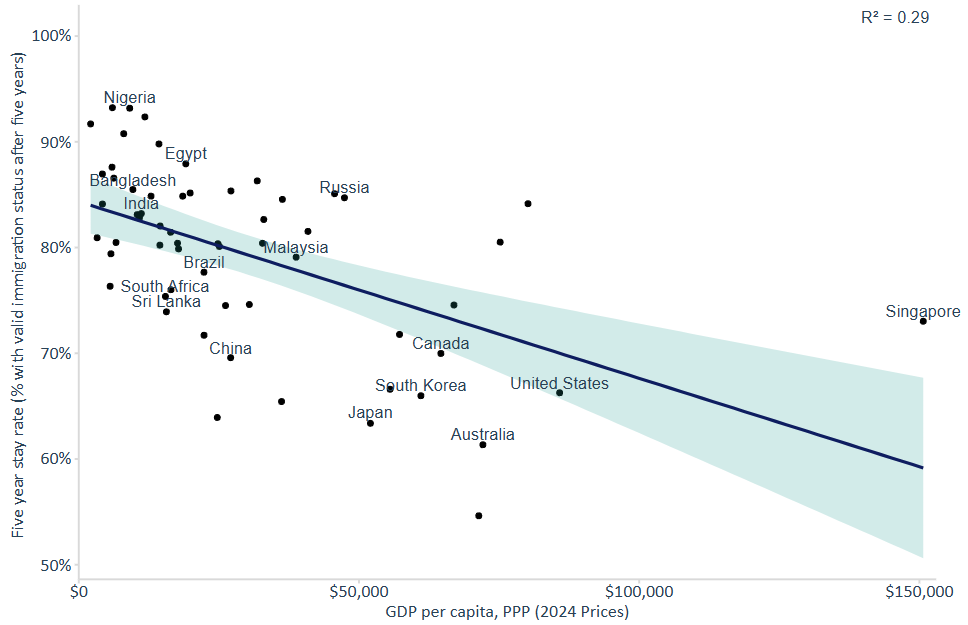
Figure 4. MAC Figure 4.3: Five-year stay rate by GDP per capita (PPP) of country of nationality. Source: MAC internal analysis using World Bank data (M1). Interpretation: migrants from higher-income countries tend, on average, to have lower stay rates, weakening any assumption that longer settlement qualifying periods would reliably retain the most globally mobile groups.
The behavioural response to a settlement delay may include stress, reduced integration, employer dependence, job immobility, inability to buy housing, family planning disruption, increased costs, irregularity risk, caseworking pressure, or departures by people the United Kingdom would otherwise have retained. A stay-rate model does not answer those questions. Nor does the absence of perfect data lower the Government's evidential burden. Where a decision would materially affect settlement expectations, evidential gaps identify questions the Government must answer, not assumptions individuals must absorb. Before applying reform to existing cohorts, the Government should publish a proper transitional evidence framework addressing, at minimum:
- Transitional Impact Assessment.
- Household Impact Assessment.
- Behavioural Response Modelling.
- Employer Dependence Analysis.
- Administrative Capacity Assessment.
SWJA's wider evidence on workforce impact and path-dependent financial commitments is therefore directly relevant [M12] [M13].
Conclusion: Prospective Reform, Transitional Protection
The policy choice is not between reform and no reform. It is between prospective reform with transitional integrity and mid-pathway alteration that reallocates systemic adjustment costs and public-law risk onto individuals, families, employers and public services. The MAC report is best understood as evidence for careful prospective calibration, not as an evidential licence for retrospective or substantively retrospective settlement delay. If Government nevertheless relied on the report to alter existing pathways without a proper transitional impact assessment, the resulting decision would risk exposure to public-law challenge on grounds including insufficient evidence, procedural unfairness or irrationality.
Transitional protection need not treat every person in the United Kingdom identically. It may be designed through cut-off dates, savings provisions or staged arrangements. The central requirement is that the Rules distinguish future entrants from those already admitted and progressing under the five-year framework.
The range of possible transitional models may be wider than is often assumed. In addition to grandfathering, cut-off dates and staged implementation, policymakers could consider an optional intermediate residence structure for existing participants already progressing through established Skilled Worker pathways. One illustrative example would be a protected long-term residence status available to those completing the current five-year qualifying period. Such a status could preserve secure residence, unrestricted work rights and access to core public services, while deferring full settlement rights or specified additional entitlements until a later point. Individuals could then choose either to continue through the longer earned-settlement pathway or to enter an intermediate long-term residence route designed for existing cohorts.
The purpose of identifying such a model is not to endorse any particular policy outcome, but to demonstrate that the policy design space is not limited to a binary choice between immediate settlement and a universal extension of qualifying periods. The EU Settlement Scheme provides an example of a staged residence structure, showing that UK immigration policy is capable of accommodating transitional residence categories where policymakers consider them appropriate. Whether such a model would be desirable is ultimately a matter for policymakers. However, its existence as a plausible design option highlights a broader point: if less disruptive transitional approaches are available, applying the most disruptive option to existing cohorts requires correspondingly stronger justification.
The report's most important lesson is not that high-retention groups can be left longer in conditional status. It is that high retention is evidence of deeper reliance, not evidence of lower vulnerability. The appropriate policy response is therefore not to disregard the MAC evidence, but to use it for future route design while expressly grandfathering existing Skilled Worker settlement pathways.
Disclaimer and Rights
This work is licensed under the Creative Commons Attribution-ShareAlike 4.0 International Licence. The Skilled Worker Justice Alliance encourages the circulation, quotation, translation, adaptation and discussion of this memorandum among stakeholders, policy makers, parliamentarians, researchers, legal practitioners, civil society organisations and affected individuals, provided that:
1. Attribution is given to the Skilled Worker Justice Alliance as the original source;
2. Any changes, adaptations or translations are clearly identified as such; and
3. Any adapted material is shared under the same or a compatible licence.
References to or adaptations of this memorandum should not misrepresent the substance of the analysis or imply endorsement by the Skilled Worker Justice Alliance unless expressly authorised.
This memorandum is provided for legislative scrutiny, public policy analysis and general information purposes only. It does not constitute, and should not be relied upon as, legal advice, immigration advice or professional advice.
The Skilled Worker Justice Alliance Ltd accepts no liability for any action taken, or not taken, on the basis of the information contained in this memorandum. Individuals affected by immigration law or policy changes should seek independent legal advice from a qualified adviser where necessary.
Materials Considered
[M1] Migration Advisory Committee (2026). Who stays, who leaves? Evidence from administrative records on the Skilled Worker route. GOV.UK, published 12 May 2026. Available at: https://www.gov.uk/government/publications/who-stays-who-leaves-evidence-from-the-skilled-worker-route/who-stays-who-leaves-evidence-from-administrative-records-on-the-skilled-worker-route-accessible (Accessed: 2 June 2026).
[M2] Skilled Worker Justice Alliance (SWJA) (2026). Written Evidence 01: Transitional fairness and established Skilled Worker pathways (SWJACP01 / SCI0610). London: Skilled Worker Justice Alliance. Available at: https://swja.uk/publications/transitional-fairness-skilled-worker-pathways/ (Accessed: 2 June 2026).
[M3] Skilled Worker Justice Alliance (SWJA) (2026). Framework Note 01: Structural Integrity and Transitional Consistency in the Skilled Worker Settlement Framework: Application to Existing Pathways (SWJACP02). London: Skilled Worker Justice Alliance. Available at: https://swja.uk/publications/skilled-worker-settlement-transitional-consistency/ (Accessed: 2 June 2026).
[M4] Skilled Worker Justice Alliance (SWJA) (2026). Legislative Scrutiny Memorandum: CP1448 and the Public-Law Boundary of Settlement Reform: Ooi, HSMP Forum and Transitional Protection for Existing Skilled Worker Settlement Pathways (SWJACP04). London: Skilled Worker Justice Alliance. Available at: https://swja.uk/publications/earned-settlement-public-law-boundary/ (Accessed: 2 June 2026).
[M5] Home Office (2026a). Immigration Rules: Appendix Skilled Worker. GOV.UK. Available at: https://www.gov.uk/guidance/immigration-rules/immigration-rules-appendix-skilled-worker (Accessed: 2 June 2026).
[M6] Home Office (2026b). Skilled Worker visa. GOV.UK. Available at: https://www.gov.uk/skilled-worker-visa (Accessed: 2 June 2026).
[M7] Home Office (2026c). Indefinite leave to remain if you have a Skilled Worker, Health and Care Worker, T2 or Tier 2 visa. GOV.UK. Available at: https://www.gov.uk/indefinite-leave-to-remain-tier-2-t2-skilled-worker-visa (Accessed: 2 June 2026).
[M8] Home Office (2026d). Continuous residence guidance. GOV.UK caseworker guidance. Available at: https://www.gov.uk/government/publications/continuous-residence-caseworker-guidance/continuous-residence-guidance-accessible-version (Accessed: 2 June 2026).
[M9] Home Office (2026e). Check if you need a UK visa: "Can settle: Yes - after 5 years". GOV.UK digital eligibility output, printed 24 February 2026. Available at: https://swja.uk/documents/pdfs/home-office-check-uk-visa-skilled-worker-settlement-output.pdf (Accessed: 2 June 2026).
[M10] Perma.cc (2025). You need a visa to work in the UK: Check if you need a UK visa - GOV.UK. Archived 26 November 2025. Available at: https://perma.cc/A9SX-TWEJ (Accessed: 2 June 2026). Backup archive: https://perma.cc/W8GH-7QDQ (Accessed: 2 June 2026).
[M11] Skilled Worker Justice Alliance (SWJA) (2026). Written Evidence 02: Earned Settlement and Existing Skilled Worker Pathways: Poverty Exposure within an Established Framework (SWJACP03). London: Skilled Worker Justice Alliance. Available at: https://swja.uk/publications/earned-settlement-poverty-exposure/ (Accessed: 2 June 2026).
[M12] Movement Research Unit and Skilled Worker Justice Alliance (2026). Evidence Note 02: Technical Analysis and Workforce Impact Assessment of Proposed Retrospective Settlement Reform under the Earned Settlement Proposal (SWJANE02). Available at: https://swja.uk/publications/retrospective-settlement-reform-workforce-impact/ (Accessed: 2 June 2026).
[M13] Movement Research Unit and Skilled Worker Justice Alliance (2026). Evidence Note 03: Financial Commitments on the Skilled Worker Route: Path-Dependent Costs and Implications of Extending Settlement Requirements (SWJANE03). Available at: https://swja.uk/publications/financial-commitments-skilled-worker-route/ (Accessed: 2 June 2026).